Follow the Three-Legged Crow in Tokyo

The Three-Legged Crow, Yatagarasu. It sees the path you cannot. You’d be wise to follow its guidance.
THE STORY
Who — Japanese Ancestors + Crows
When — Spring 2026
Where — Tokyo
Fire Light — Finding the Way By Paying Attention to Nature
Follow the Three-Legged Crow in Tokyo
Shinjuku · Tokyo · Shinto
On finding wildness, roots, and divine guidance in the most electric city on Earth.
---
I left my hotel just after sunrise, the streets of Shinjuku already humming with delivery trucks and the first salaried workers striding toward the towers. I had no particular plan — just the instinct to walk, and a vague sense that somewhere in this city of thirteen million, something old was waiting to be found. I found it within fifteen minutes. Through a gap between glass buildings, half-hidden by a worn stone torii gate, was Juniso Kumano-jinja Shrine.
I stepped through the gate and the city fell away. Not gradually — all at once, the way sound drops when you close a heavy door. The air changed temperature. My feet found gravel. Incense drifted from somewhere I couldn't see. I stood still for a long moment, the way you do when you realize you've accidentally walked into a room that matters.
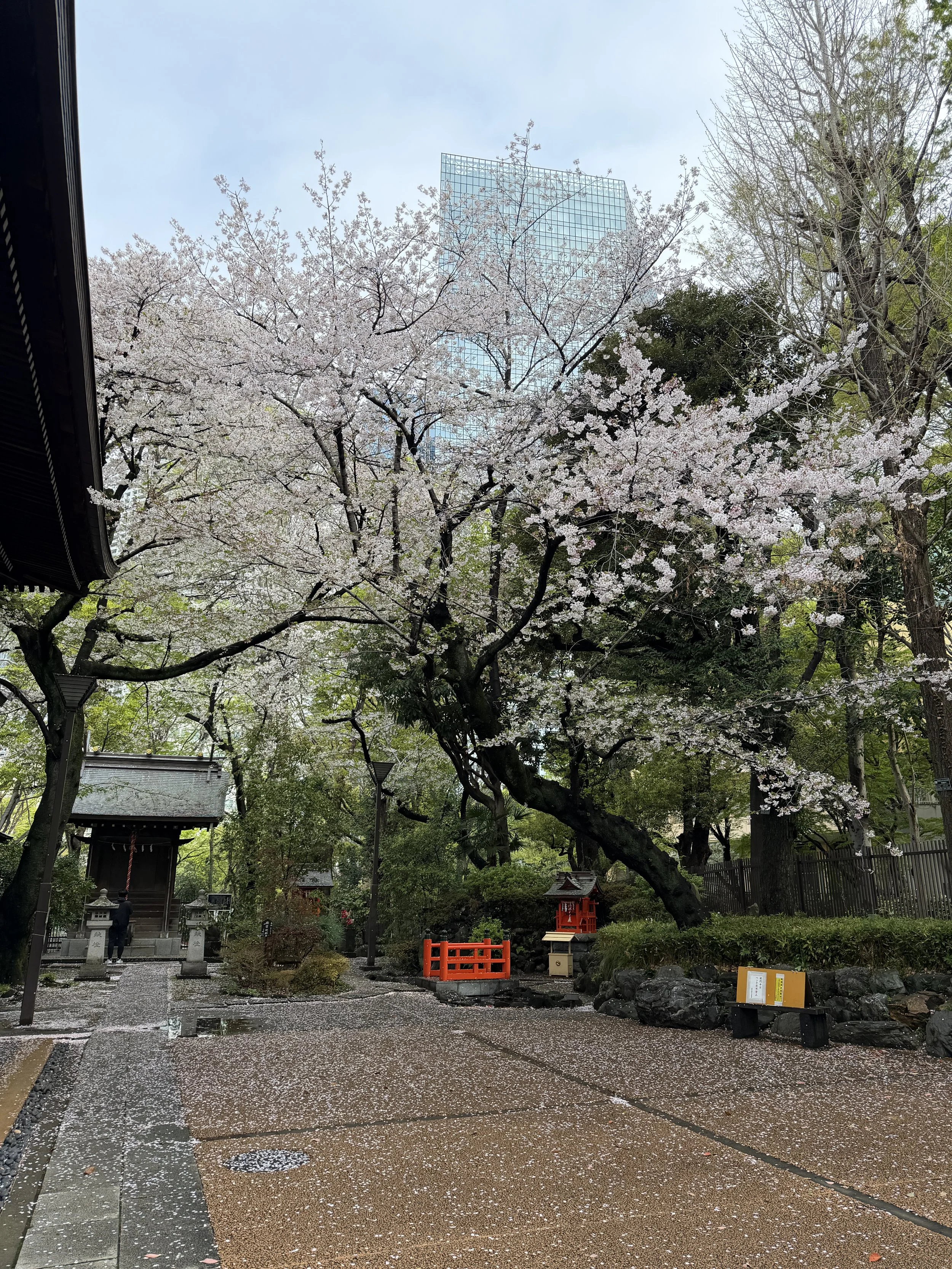
Kumano-jinja Shrine in Tokyo as cherry trees bloom, with modern skyscrapers behind
I have walked the Kumano Kodo, the ancient pilgrimage trail in the mountains of Wakayama, and I recognized this shrine immediately as its spiritual offspring. Juniso Kumano-jinja was founded in the early 1400s by a man named Suzuki Kuro, who had traveled from Kishu — the old name for Wakayama — and wanted to carry the sacred spirit of the Kumano mountains into the city he had made his home. Six centuries later, surrounded by skyscrapers, it is still doing exactly that.
This is what Tokyo taught me: the wild doesn't only live in mountains. Sometimes it takes up residence between a convenience store and a glass tower, and waits for you to notice.
---
THE THREE-LEGGED GUIDE IN THE CONCRETE FOREST
At the shrine, I saw it: the Yatagarasu. A three-legged crow, carved in stone, its posture neither aggressive nor gentle but something rarer — certain. If you don't know what you're looking at, you might walk past it. But it's worth stopping for.

The three-legged crow sees the path when you cannot.
In Japanese mythology, the Yatagarasu was sent by the Sun Goddess to guide Emperor Jimmu through the dense, trackless mountains of Kumano when he was utterly lost. The crow didn't whisper suggestions. It showed the way — boldly, from above, with the advantage of a perspective the wanderer on the ground couldn't have. This is the bird's whole nature: it sees the path when you cannot.
Here's what I love about this, and what surprises most Westerners: the Yatagarasu is not a creature of darkness. In Western traditions, crows and ravens carry the underworld on their wings — omens, death-messengers, Poe's harbingers of grief. The Yatagarasu is the opposite. He is a solar being, an avatar of the sun itself. His three legs represent the three phases of the day — dawn, midday, dusk — and more deeply, the three pillars of existence: Heaven, Earth, and Humanity. He doesn't lead you into darkness. He leads you out of it.
On the Yatagarasu:
His name means "Eight-Span Crow" — and in ancient Japan, eight meant infinite.
He is not a small clever bird pulling tricks. He is a vast, awe-inspiring celestial
presence. Look at the talons on a Yatagarasu statue: sharp, powerful, gripping.
Divine guidance, the shrine reminds us, is not a gentle nudge. It is a piercing
truth that grabs hold of you.
What struck me about finding this figure in the middle of Shinjuku — Japan's most frenetic business district — is the deliberateness of the message. In the tangle of deadlines and ambition and noise that defines modern urban life, the shrine is saying: you are not without a guide. The wild intelligence that helped the first Emperor find his way through impossible terrain is still here, perched in a courtyard between skyscrapers, waiting for anyone willing to stop and look up.
---
THE FOREST THAT FOUR GENERATIONS BUILT FOR US
Later that morning I made my way to Meiji Jingu, the great shrine in Harajuku dedicated to Emperor Meiji and Empress Shoken. The walk through its forested approach is one of the most disorienting experiences Tokyo offers — disorienting in the best sense, the kind that makes you question what year it is.
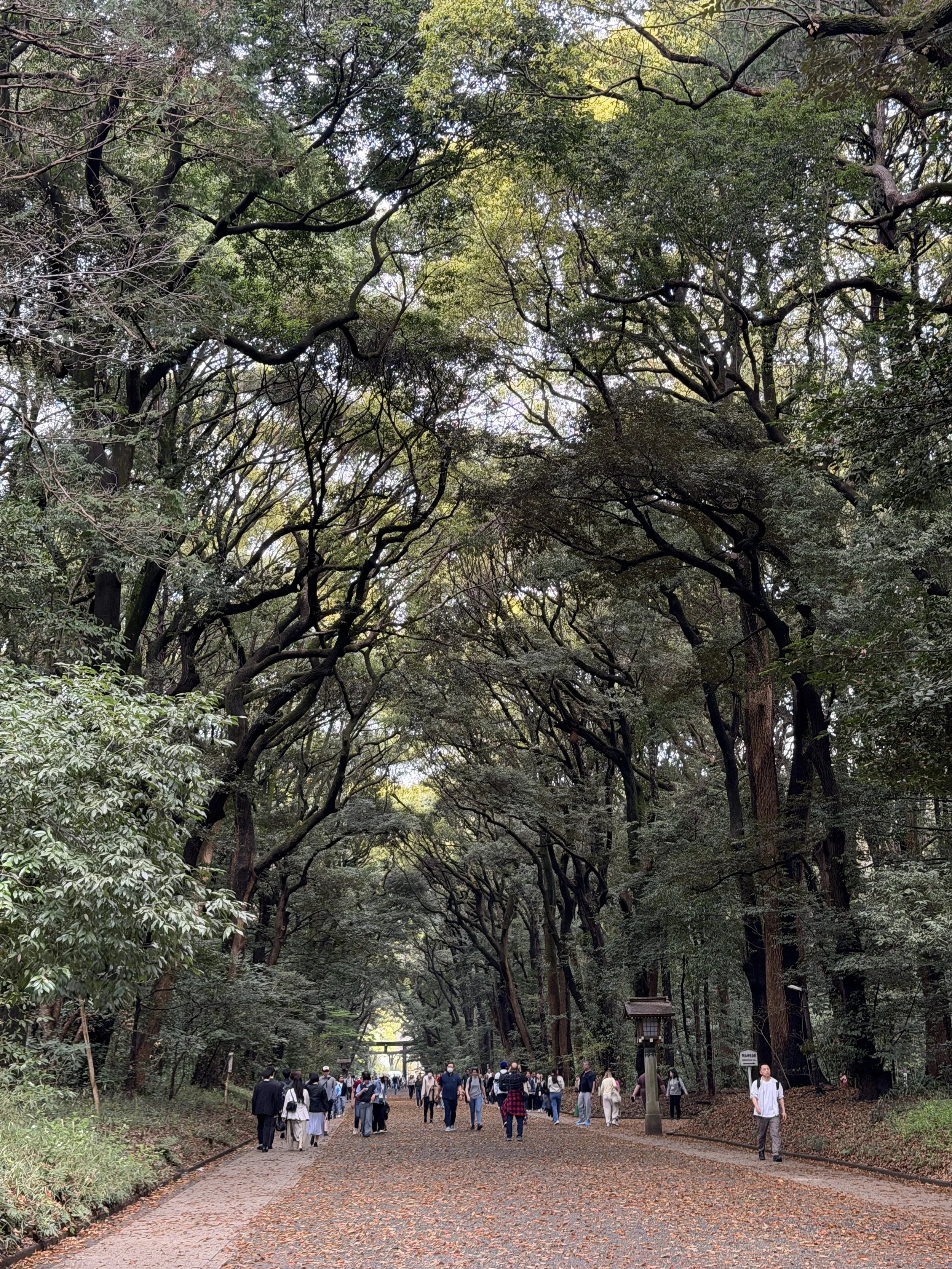
The forest feels primeval. Too old for this modern city. The canopy is thick and filters the light into something green and underwater. The air is cooler and cleaner than in the streets outside the gated entrances. The sounds of Harajuku — one of the most fashionable, frantically trendy neighborhoods on earth — simply cease to exist.
And then you learn the secret: this forest is one hundred years old and every tree was planted with a long-term vision. In 1920, when the shrine was built to honor the recently passed Emperor Meiji, a team of scientists led by Dr. Seiroku Honda drew up what they called a hundred-year plan. They collected 100,000 trees donated by people from every prefecture across Japan — a national act of devotion — and planted them not for beauty or spectacle, but for permanence. They planted fast-growing pines first, to provide cover, then interplanted slower oaks and camphor trees that would outlive the pines by centuries. As the pines naturally died, the broadleaf evergreens took over. The forest engineered its own succession, exactly as planned.
The people who planted this forest knew they would never see it in its prime. They planted it anyway.
Since 1920, the forest has been left almost entirely untouched. No trees are cut. Fallen leaves are swept back in to rot and feed the soil. Not a branch is removed. The instructions left by its creators were simple: let it be. What they gave us is a patch of earth that functions today exactly as a forest would have a thousand years ago, in a city that otherwise feels like it's living in the year 3000.
I find this almost unbearably moving. It is one of the most generous things I have encountered — an act of ecological foresight so long-term that the people who performed it couldn't benefit from it themselves. They were planting for strangers not yet born - For us.
---
TWO TREES, ONE ROPE
Deep in the Meiji Jingu grounds, I came across the Meoto Kusu — two enormous camphor trees growing so close together that they have, over the decades, partially merged. A thick shimenawa rope ties them together at the trunk, the Shinto symbol of the sacred. They are called the Husband-and-Wife Trees.
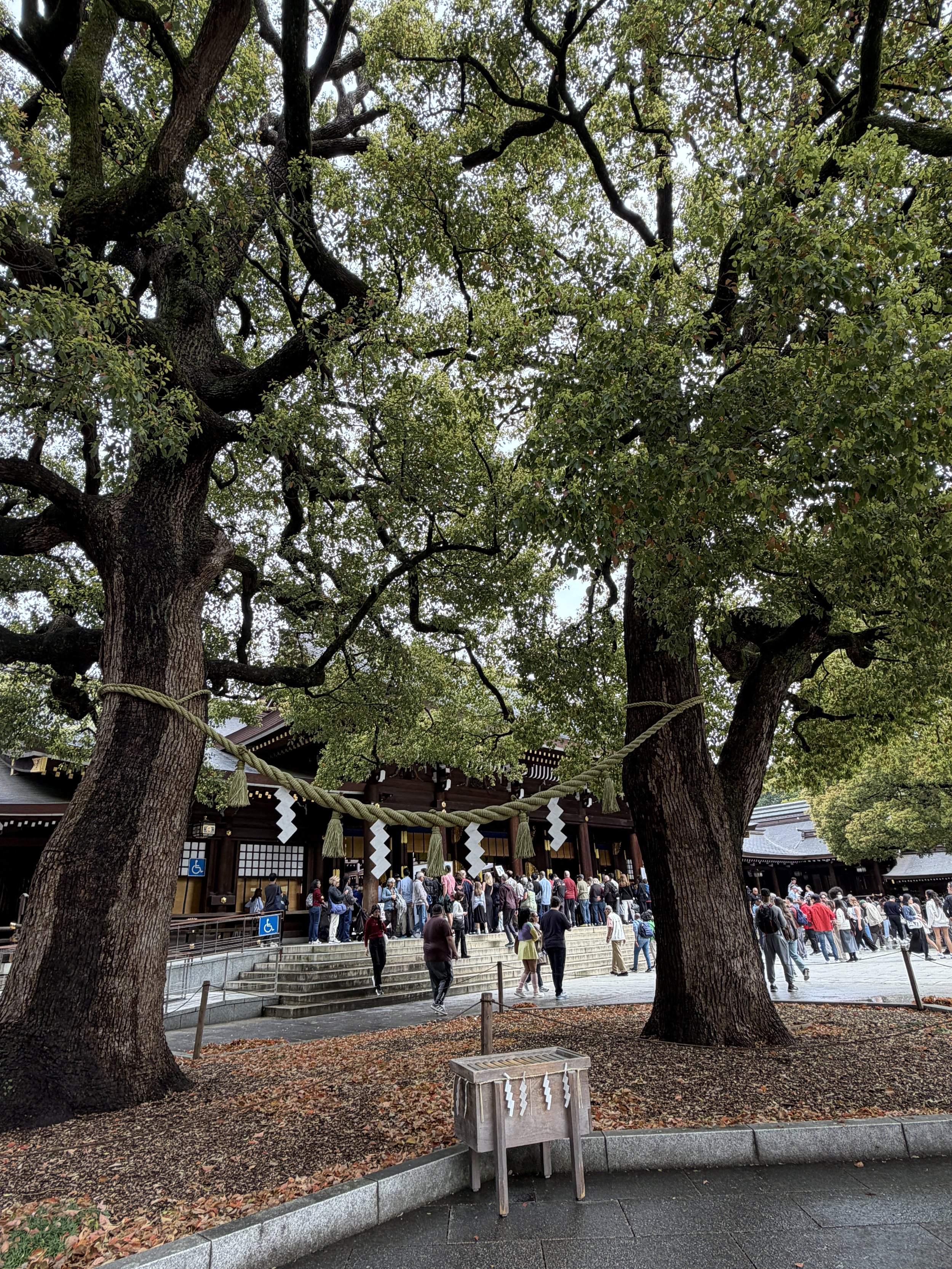
Husband-and-Wife Trees joined by their roots and these adornments
I stood with them for a while. There is something in the image — two living things, rooted in the same earth, growing alongside each other for long enough that the boundary between them softens — that says everything about partnership that language tends to overcomplicate. They don't need to be the same tree. They choose to be close enough, long enough, that the line between them begins to blur.
---
WHAT TOKYO IS SHOWING US
I walked back to my hotel in Shinjuku through crowd-packed sidewalks and brightly lit screens promoting things I can’t even understand. Past towers with vast underground mazes of restaurants and shops. I had a shopping bag full of powdered matcha, but that wasn’t the only thing different I was carrying since starting my wander at dawn.
Tokyo is a city that could have abandoned its relationship with Nature entirely. It is one of the most technologically sophisticated places on earth — a city that in many ways feels like “the future”. And yet, woven into its fabric, at a density that you only notice when you start looking, are these anchors:
- A shrine between the towers.
- A forest planted by the dead for the living.
- A solar crow perched in a business district, reminding anyone who stops to look that there is still a path through the tangle, if you're willing to let something wiser than your own anxiety lead the way.
In Shinto, the divine does not live in a distant heaven. It lives in the old camphor tree. In the moss on the stone lantern. In the particular quality of light through a forest canopy that someone planted a century ago knowing they would never see it.
The Yatagarasu watches from above. He has always known the way. The question is only whether we're willing to look up from the noise long enough to follow his fierce path.
