Over the Precipice: Calming Mind and Body
THE STORY
Who — Tommy
When — TBD
Where — Table Mountain Cape Town, South Africa
Fire Light — Thresholds & Comfort Zones
Over the Precipice: Calming Mind and Body
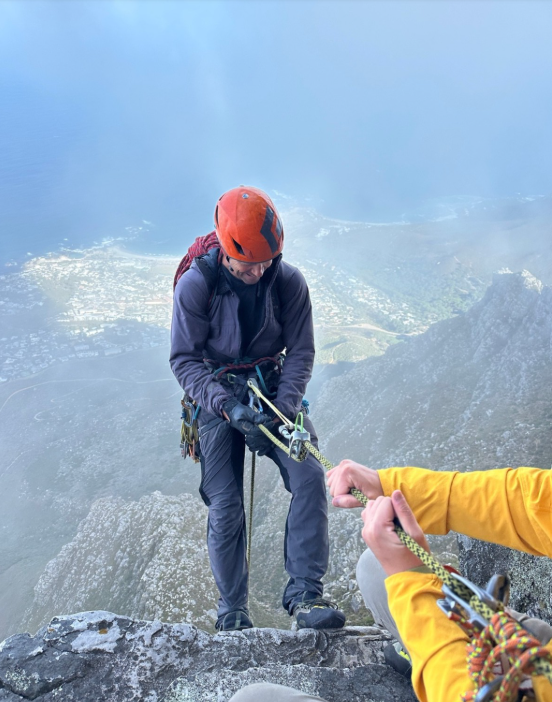
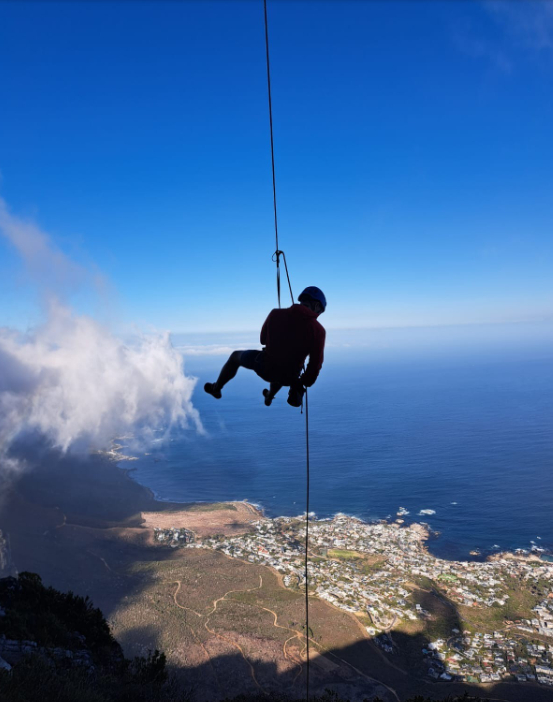
My heels hang over the open abyss as cloud and mist blow under them. I'm several hundred feet off the ground, secured by rope and metal tools to the granite of Table Mountain. Above me I hear Tommy starting to panic. He's saying "I can't do it. I can't do it." There's a quiver in his voice that I know all too well: the sound of fight/flight/freeze beginning to take over.
It's not a safe way to be on a multi-pitch trad climb along giant cliffs in South Africa. But it's also totally natural and normal.
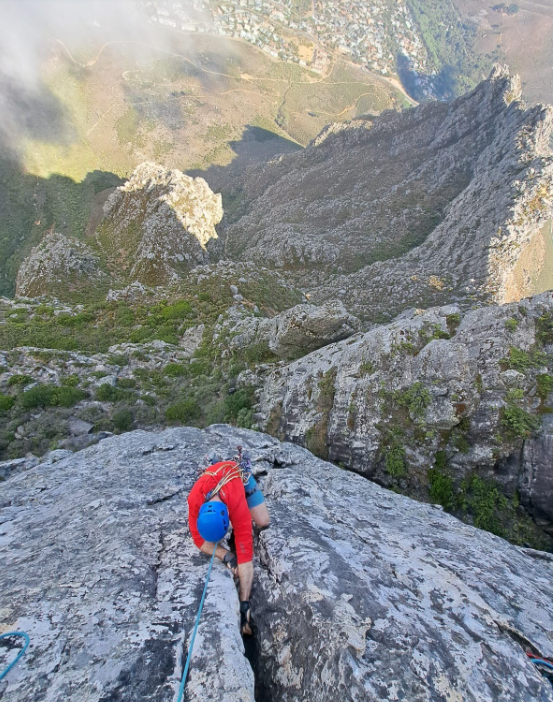
Tommy (not his given name) is on his first multi-pitch rock climb and he picked a doozie. This route up Table Mountain has immense exposure up a sheer cliff face, so it's no surprise his sympathetic nervous system is taking over. Fight-flight-freeze is our ancient programming kicking in to get us out of situations that feel unsafe. In Tommy's case it won't help at all: there's no one to fight, nowhere to run, and freezing in place will just lead to exhaustion as he over-grips the rock. If you've tried rock climbing or another extreme sport, you know this feeling. It's not a "bad" space to be. In fact it might be a great space to grow, as long as you have the skills to not get consumed by the fear.
Luckily for Tommy he had local rock guide Justin Lawson above him and me below him. We heard his moment of panic and engaged with gentle support. Through simple breath practices (box breathing and extending the out-breath longer than the in-breath), plus a few cognitive shifts ("I'm securely attached to a safety rope"; "This is fun. I'm in Cape Town climbing and it's fun!"), we helped Tommy pause, reorganize his nervous system, and return to ascending the magnificent rock face.
This skill of activating your parasympathetic nervous system, the rest-and-digest response, is essential when approaching the threshold between comfort and discomfort. Going into fight-or-flight is generally automatic, but pulling back on the reins of that wildly reactive horse before it bucks you off is not. It requires awareness, skill and practice. The good news is that both the breath work and the cognitive reframes are learnable, portable tools you can deploy anywhere: on a cliff face, in a boardroom, or in the middle of a hard conversation.
That threshold between fear and calm, safety and danger, known and unknown, is a space I know well and cherish. It's ripe for growing into a more capable person across every dimension of resilience: mental, physical, emotional, social and spiritual. From youth at wilderness summer camps to adults in corporate workshops, I’ve explored countless ways to push up against perceived limits and safely expand them. The result is a larger comfort zone, which allows one to experience a more vibrant life as you go places you didn’t think were possible (both in the physical and mental realms) – where you can find treasures of meaning, purpose, health and belonging.
Tommy was ecstatic when he reached the top. His confidence was bubbling over as we took in the breathtaking view of ocean, beaches, city and mountains. Had he quit, he would have robbed himself of this awesome experience and his comfort zone would have shrunk rather than expanded. All it took was the willingness to put himself in a challenging environment and a few simple skills to regulate his nervous system.
I smile to think of the climbs he'll do next, and perhaps one day the people he'll take with him. That's what it's all about.
Contact me if you're interested in expanding your comfort zones, whether mentally, physically, emotionally, socially or spiritually. Let's approach that threshold together, peer over the edge, and see what's on the other side.
